Concrete Driveway Repair vs. Replacement

March 2, 2026
Call Us
Concrete Driveway Repair vs. Replacement in Clarkstown, NY | Clarkstown Concrete
Clarkstown Concrete — Homeowner's Guide

Concrete Driveway Repair vs. Replacement in Clarkstown, NY

Your driveway took a beating this winter. Before you call anyone, here's what every Rockland County homeowner needs to know about when to fix it — and when to start fresh.

Published March 2026  ·  8 min read  ·  Clarkstown, NY & All of Rockland County

Every spring in Clarkstown, the same scene plays out across neighborhoods from New City to Nanuet: homeowners walk out to their driveways after months of freeze-thaw cycles, road salt, and snowplows — and they're not happy with what they see. Cracks. Spalling. Sunken sections. Stains that won't scrub off.

The big question is always the same: do I repair this, or replace the whole thing? It's not always obvious. Repair it when you should replace it, and you'll be spending money again in two years. Replace it when a good repair would have done the job, and you've just spent $6,000–$12,000 unnecessarily.

At Clarkstown Concrete, we've assessed hundreds of driveways across Rockland County — and the answer really does depend on what's going on with your specific slab. This guide walks you through exactly how to think about it, what the warning signs mean, what each option costs in our area, and how to make the right call for your home and budget.

Quick answer: If your driveway is under 15–20 years old and damage covers less than 25–30% of the surface, repair or resurfacing is likely the right move. If it's older, structurally compromised, or damage is widespread, replacement almost always wins in the long run. Read on for the full picture.

The Core Question: Repair, Resurface, or Replace?

Before we get into specific warning signs, it helps to understand that there are actually three options — not just two. Most homeowners think in terms of "patch it" or "redo the whole thing," but there's a middle ground that's often the best value:

Concrete repair addresses specific damaged areas — individual cracks, small spalled patches, or a sunken section — while leaving the rest of the slab intact. It's the most affordable option but only works when the overall structure of the driveway is still sound.

Concrete resurfacing(also called overlaying) involves applying a thin layer of fresh concrete or polymer-modified overlay over the entire existing slab. This restores the appearance of the whole driveway and can add a decorative finish — stamped patterns, exposed aggregate, brushed textures — at a fraction of full replacement cost. It's ideal when the slab is structurally solid but cosmetically tired.

Full concrete replacement means tearing out the old slab entirely, regrading the base, and pouring fresh concrete. It's the most expensive option upfront but gives you a completely fresh start — proper drainage, modern thickness, reinforcement, and the finish of your choice. When a driveway has reached the end of its structural life, replacement is the only real fix.

Warning Signs: What Is Your Driveway Telling You?

Here's how to read the damage on your Clarkstown driveway and what each type of problem typically means for your decision:

〰️
Hairline Cracks
Thin surface cracks under ¼" wide with no vertical displacement. Very common after winter. Usually just cosmetic.
Repair or Resurface
Wide or Deep Cracks
Cracks wider than ½" or with one side higher than the other. Signals base movement or structural failure below.
Likely Replace
🧩
Spalling & Flaking
Surface layer peeling off in chunks or flakes. Often caused by road salt or a poor original mix. Small areas = resurface; widespread = replace.
Depends on Extent
📉
Sunken or Uneven Sections
Parts of the driveway sitting lower than others. Can be caused by soil erosion or base failure under the slab.
Likely Replace
🕸️
Alligator Cracking
A web of interconnected cracks resembling alligator skin. This pattern means the base has failed — no surface repair will hold.
Replace
🔵
Pitting & Surface Wear
Rough, pitted texture across the surface — common in older driveways that have never been sealed or were finished with a weak top layer.
Resurface
💧
Pooling Water
Water collecting in depressions after rain instead of draining off the edges. This means the slab has shifted and slope has been lost.
Depends on Severity
📅
Age (25+ Years)
Even a driveway that looks "okay" at 25+ years often has underlying issues. Older slabs have diminishing returns on repair investment.
Consider Replacing

The Repair vs. Replacement Decision Matrix

Still not sure which way to go? Here's the simplified framework we use when evaluating driveways for Clarkstown homeowners:

✓ Choose Repair or Resurface When...

Repair / Resurface

  • Driveway is under 15–20 years old
  • Damage is isolated to less than 30% of the surface
  • Cracks are thin and not displacing vertically
  • Base and sub-grade are still stable
  • No sunken or dramatically uneven sections
  • You want a cosmetic refresh on a solid slab
  • Budget is a primary constraint right now
→ Choose Replacement When...

Full Replacement

  • Driveway is 25+ years old
  • Alligator cracking is present
  • Large sections are sunken or displaced
  • Base or sub-grade has visibly failed
  • Damage covers more than 35–40% of surface
  • Prior repairs have failed or keep returning
  • You want a decorative finish or new layout

Watch out for this: The most common mistake we see in Clarkstown is homeowners patching an alligator-cracked driveway or one with base failure. The patch holds for one season, the cracks return — often wider — and they've paid for repairs they'll need to redo again before replacing. When the base has failed, there is no surface fix that will last.

Concrete Driveway Costs in Clarkstown, NY: What to Budget

Cost is obviously a major factor. Here's a realistic pricing guide for the Clarkstown and greater Rockland County area. These are installed prices — material plus labor — from a licensed, insured contractor:

Service Approximate Cost Best For Durability
Crack filling / spot repair $300 – $1,200 Isolated cracks, minor damage 5–10 yrs
Concrete resurfacing (overlay) $3 – $7 per sq. ft. Cosmetically tired but solid slab 8–15 yrs
Partial slab replacement $800 – $2,500 per section Isolated sunken or cracked section 10–20 yrs
Full driveway replacement (basic) $8 – $12 per sq. ft. End-of-life slab, base failure 25–35 yrs
Full replacement with stamped finish $14 – $22 per sq. ft. Upgrade + decorative curb appeal 25–35 yrs
Full replacement with exposed aggregate $10 – $16 per sq. ft. Durable, textured, non-slip finish 30+ yrs

For a typical two-car driveway in Clarkstown (approximately 600–800 sq. ft.), a basic full replacement runs roughly $5,000–$9,500. A stamped or decorative replacement on the same footprint runs $8,500–$17,500, depending on pattern complexity and site conditions.

Remember: these are Rockland County market rates. Prices in our area run higher than national averages due to local labor costs, permitting requirements, and disposal fees for demo material.

Why Concrete Beats Asphalt for Clarkstown Driveways

We get asked all the time: "Should I just do asphalt instead?" It's a fair question — asphalt is less expensive upfront. But for most homeowners in Clarkstown and the wider Rockland County area, concrete wins over the long haul for several reasons.

Longer lifespan. A properly installed concrete driveway lasts 30–50 years. Asphalt typically needs significant maintenance every 3–5 years and full replacement in 20–30 years.

Lower maintenance costs. Asphalt requires regular sealcoating (every 2–3 years) to prevent cracking and oxidation. Concrete needs resealing far less often and doesn't soften in summer heat.

Curb appeal and home value. Concrete — especially a decorative stamped or exposed aggregate finish — looks significantly more upscale than asphalt and consistently adds more to a home's perceived value.

Winter performance. Contrary to a common myth, quality concrete handles Rockland County winters extremely well when it's properly installed with the right mix design and adequate sealing. The key word is properly — this is where contractor selection matters enormously.

How Clarkstown's Climate Affects Your Driveway

Anyone who's lived in Rockland County for a few winters knows what concrete is up against. We typically see 25–35 freeze-thaw cycles per year, combined with heavy road salt application from November through March. This combination is the primary enemy of concrete driveways throughout Clarkstown, New City, West Nyack, and Valley Cottage.

Here's what happens: water seeps into micro-cracks and pores in the concrete surface. When temperatures drop below freezing, that water expands as it becomes ice — creating internal pressure that widens cracks and pops off the surface layer (spalling). Salt accelerates this by drawing moisture deeper into the slab and chemically attacking the concrete matrix over time.

The best protection is a combination of proper installation (right mix design, adequate thickness, quality finishing) and routine maintenance — specifically sealing your driveway every 2–3 years with a high-quality penetrating sealer, and avoiding rock salt in favor of calcium magnesium acetate (CMA) or sand for winter traction.

Serving All of Clarkstown and Rockland County

Clarkstown Concrete is based right here in the community. We know the soil conditions in West Nyack, the HOA rules in certain Nanuet neighborhoods, and the permit requirements for different villages throughout Rockland County. We're not a franchise or out-of-area crew — every estimate is done in person by an experienced member of our team.

Clarkstown
New City
Nanuet
West Nyack
Valley Cottage
Congers
Pearl River
Bardonia
Blauvelt
Orangeburg
New Hempstead
Stony Point
Spring Valley
Haverstraw

Frequently Asked Questions

How do I know if my driveway's base has failed?
The clearest signs are sections that have sunk significantly below the surrounding area, wide cracks where one side is noticeably higher than the other, or alligator-pattern cracking across large areas. If you're unsure, our team can assess this during a free on-site visit — we probe the sub-grade and check for voids beneath the slab before making any recommendation.
Can concrete resurfacing be done in the winter?
No — concrete resurfacing and replacement both require temperatures consistently above 40°F (ideally 50°F+) to cure properly. In Rockland County, this means the window is roughly April through November. Spring bookings fill up fast, so we recommend getting your estimate in late winter so you're first in line when the weather cooperates.
How long does a driveway replacement take in Clarkstown?
Demo and excavation of a typical two-car driveway takes half a day to a full day. Forming, pouring, and finishing takes another day. Concrete needs to cure for 24–48 hours before foot traffic and 7 days before you drive on it. Most projects are fully complete and ready for vehicles within 8–10 days of start.
Do I need a permit to replace my driveway in Clarkstown?
In most cases, a straightforward driveway replacement on the same footprint does not require a permit in Clarkstown. However, if you're expanding the driveway, changing its location, or affecting drainage patterns, a permit may be required. We handle this assessment as part of the free estimate process and can advise you on exactly what's needed for your specific address.
Is it worth replacing a driveway before selling my home?
In most cases, yes — especially if the current driveway is visibly cracked, stained, or sunken. A new concrete driveway is one of the first things buyers see and can meaningfully improve first impressions and perceived home value. A decorative stamped or exposed aggregate finish can make the exterior of a home look dramatically more upscale at a competitive price point. We work with homeowners and their real estate agents throughout Rockland County on pre-sale upgrades regularly.
What type of concrete finish should I choose for my new driveway?
For a clean, traditional look: broom-finished concrete is durable, affordable, and time-tested. For added texture and visual interest without a premium price: exposed aggregate is extremely popular in our area. For maximum curb appeal and a custom look: stamped concrete in a brick, cobblestone, or ashlar pattern adds dramatic character. We bring samples to every on-site consultation so you can see the options before deciding.
Free Estimates — No Obligation

Not Sure What Your Driveway Needs? Let's Find Out Together.

We'll visit your property, assess the damage honestly, and give you a clear recommendation — repair, resurface, or replace — with a detailed written estimate. No pressure, no upsells.

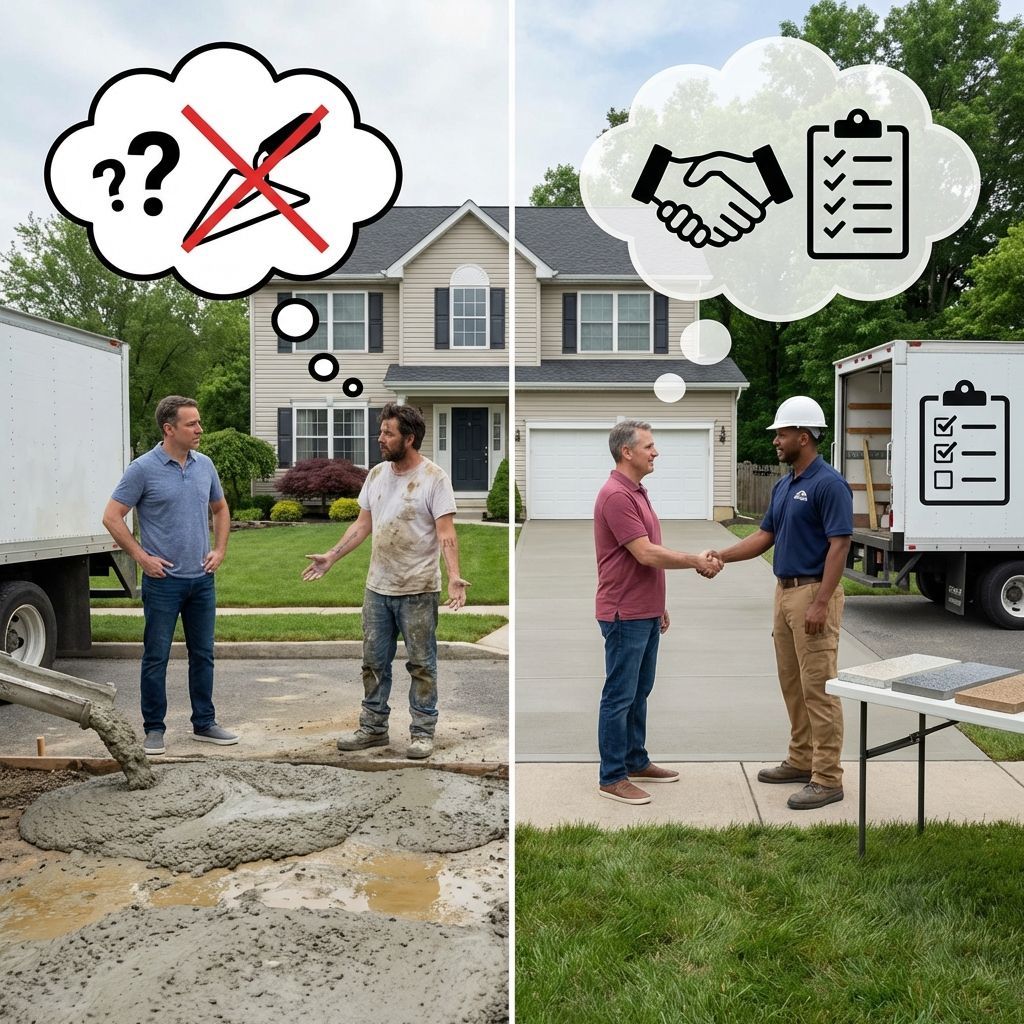
February 18, 2026
Concrete is one of the most permanent decisions you'll make about your home. A poorly installed driveway, patio, or foundation doesn't just look bad — it fails. And in Rockland County, where winter freeze-thaw cycles can destroy improperly mixed or finished concrete within a few seasons, the contractor you choose determines whether your investment lasts 30 years or needs replacement in five. The Clarkstown concrete market has the same problem as most suburban New York contracting markets: it's easy to find someone willing to pour concrete, and very hard to tell the difference between a professional operation and a crew that will do substandard work, take your deposit, and be unreachable when the cracks appear in spring. This guide explains exactly what to verify before you hire anyone to pour concrete on your Clarkstown property. 1. New York State Licensing — What's Actually Required Here New York State does not license individual concrete contractors at the state level the way California does with its C-10 license. However, Rockland County and the Town of Clarkstown have their own contractor registration and permitting requirements that matter just as much. Any concrete project in Clarkstown that involves structural work — foundations, retaining walls, concrete slabs connected to a structure — requires a building permit from the Town of Clarkstown Building Department. Driveways and patios that meet certain size thresholds may also require permits depending on the scope of work. What to ask every contractor: "Will you pull the permit for this project?" If the answer is no or they suggest you pull it yourself, that's a red flag. Licensed, legitimate contractors in Rockland County handle their own permits. "Are you registered with Rockland County as a home improvement contractor?" New York requires any contractor performing home improvement work to register with the county. You can verify contractor registrations through the Rockland County Consumer Protection office. "Do you carry general liability insurance and workers' compensation?" Get the actual certificates — not just a verbal yes. Unregistered, uninsured contractors are common in the Hudson Valley home improvement market. If something goes wrong with an unlicensed crew — a worker injury, property damage, a failed inspection — you bear the liability. The few hundred dollars you might save hiring the cheapest option can become tens of thousands in exposure. 2. The Freeze-Thaw Problem: Why Clarkstown Concrete Mix Matters More Than You Think This is the technical factor that separates contractors who understand Rockland County from those who don't. Clarkstown experiences roughly 100 freeze-thaw cycles per year — days where temperatures cross above and below 32°F. Every time this happens, water that has entered porous concrete expands as it freezes, creating internal pressure that gradually breaks down the concrete matrix. This is called freeze-thaw spalling, and it's the primary reason driveways and patios in the Northeast fail long before their expected lifespan. The solution isn't complicated — but it requires a contractor who actually specifies it: Proper concrete mix for Rockland County conditions: Minimum 4,000 PSI compressive strength for driveways and exterior flatwork (some contractors cut costs using 3,000 PSI, which is insufficient for our climate) Air entrainment of 5–7% — microscopic air bubbles deliberately introduced into the mix that give water room to expand during freezing without fracturing the concrete Water-cement ratio no higher than 0.45 — lower ratios produce denser, less permeable concrete that resists moisture infiltration When you're getting quotes, ask each contractor: "What PSI mix are you specifying, and will the concrete be air-entrained?" A contractor who can answer this specifically and explain why it matters for New York winters knows what they're doing. A contractor who gives you a vague answer, tells you "it's standard mix," or doesn't know what air entrainment means is not the right person to pour your driveway. This is not an obscure technical detail — it's basic concrete specification for cold climates. Any professional concrete contractor in Rockland County should answer this question immediately and confidently. 3. Subbase Preparation: The Work You'll Never See That Determines Everything The most consequential work in any concrete project happens before a single cubic yard of concrete is poured. Subbase preparation determines whether your new driveway or patio remains flat and crack-free for decades, or begins settling and cracking within a few years. What proper subbase preparation includes for Clarkstown properties: Clarkstown sits on a mix of soil types — from the sandy loams near the Hackensack River watershed to heavier clay soils in the upland areas of New City and West Nyack. Clay soils in particular are problematic for concrete because they expand when wet and contract when dry, creating movement beneath the slab. A contractor who doesn't account for your specific soil conditions is guessing. Proper subbase work involves: Excavating to the correct depth — typically 6–8 inches below finished grade for driveways, accounting for the concrete thickness plus compacted base material Compacted gravel base of 4–6 inches — provides drainage and a stable platform that won't shift with soil movement or freeze-thaw cycles Addressing drainage before pouring — water that pools under a slab accelerates heaving and cracking. A competent contractor evaluates drainage patterns before work begins and grades accordingly Rebar or wire mesh reinforcement where appropriate — for driveways and slabs that will carry vehicle loads, internal reinforcement isn't optional Ask any contractor you're considering: "How deep are you excavating, and what thickness of compacted base are you installing?" If they're not specifying at least 4 inches of compacted gravel base on top of proper excavation, they're cutting a corner that will cost you money later. 4. Concrete Finishing and Curing: Where Visible Quality Comes From Two additional factors determine the long-term performance and appearance of your concrete: Finishing. Exterior concrete in Clarkstown should have a broom finish — a texture applied while the concrete is still plastic that provides traction in rain and ice and helps the surface resist spalling. Contractors who over-trowel exterior concrete (creating a smooth, shiny surface) are actually reducing its durability in freeze-thaw conditions because the dense surface layer can delaminate. For stamped concrete, the skill of the finishing crew is everything — patterns need to be applied at the right concrete consistency, and color hardeners need to be properly broadcast and worked in. Ask to see photos of completed stamped projects, not just renders or catalog images. Curing. Fresh concrete needs to retain moisture for a minimum of 7 days after pouring to properly hydrate and reach design strength. In summer heat, this means covering slabs with curing compound or wet burlap. In cold weather, it means protecting fresh concrete from freezing — concrete poured when temperatures are below 40°F requires cold-weather protection protocols including heated enclosures or insulating blankets. Ask: "How do you handle curing, and what are your cold-weather concrete procedures?" Any contractor pouring concrete in October through April in Rockland County who doesn't have a specific answer to the cold-weather question is flying blind. 5. What a Real Quote Includes — and the Red Flags in Vague Ones Professional concrete contractors provide written, itemized quotes. A legitimate quote for a driveway or patio project should specify: Total square footage and thickness Concrete mix specification (PSI, air entrainment) Excavation depth and base material thickness Reinforcement type (rebar size and spacing, or wire mesh) Finish type (broom, exposed aggregate, stamped pattern/color) Included demolition and disposal of existing concrete (if applicable) Timeline and payment schedule Warranty terms Red flags in the quoting process: A quote that is just a number — "driveway, $8,500" — with no specification details is not a professional quote. You have no basis to compare it to other bids, and you have no documentation if the contractor delivers something different than what you understood you were getting. Contractors who demand large upfront deposits before any work begins (more than 25–30%) warrant caution. A standard payment structure for a concrete project is a deposit at signing, a draw at mobilization, and the remainder at completion. Be wary of contractors who offer prices dramatically below every other quote. Concrete has real material costs — the ready-mix truck, the crew, the base material. A price that seems too good to be true usually means something is being skipped: thinner concrete, no base preparation, a lower-strength mix, or a crew that won't show up when problems arise. 6. The Rockland County Permit Reality Homeowners in Clarkstown sometimes work with contractors who suggest skipping permits to save time and money. This is a mistake that compounds over time. Why permits matter for Clarkstown concrete work: A new concrete driveway, foundation, or significant patio in Clarkstown requires a building permit from the Town of Clarkstown Building Department. The permit triggers an inspection, which verifies the work meets code. That inspection record becomes part of your property's file. When you go to sell your home, unpermitted concrete work can complicate the transaction. Buyers' attorneys request building permits for any significant work, and if none exists for a clearly recent driveway or patio, it raises questions. Some lenders won't finance purchases with unresolved permit issues. You may be required to obtain a retroactive permit — which can require exposing work that's already been poured to demonstrate it was done correctly. The permit fee is a small fraction of the project cost. Any contractor who frames permit avoidance as doing you a favor is actually creating a future problem you'll deal with at the worst possible time. 7. Local References and Clarkstown-Specific Experience The final test is the simplest: ask for references from recent projects in Clarkstown and Rockland County specifically, and follow up on them. Questions worth asking references: Did the contractor show up on schedule, and did the project finish on time? Was the final price consistent with the quote? How does the concrete look after a winter or two? Any cracking or spalling? If there were any issues, how did the contractor respond? A contractor with legitimate Clarkstown experience will have references you can verify. One who is new to the market, operating under a different name after past complaints, or working primarily outside the county may not. Check Google reviews, the Rockland County Better Business Bureau, and Nextdoor for your neighborhood — Nextdoor in particular is where local homeowners give candid opinions about contractors they've actually used on their street. Clarkstown Concrete serves Clarkstown, New City, West Nyack, Nanuet, Pearl River, Valley Cottage, Congers, Bardonia, Spring Valley, Nyack, and communities throughout Rockland County. We pour driveways, patios, foundations, slabs, sidewalks, and stamped concrete with proper mix specifications for Rockland County's climate, full Clarkstown building department permit compliance, and subbase preparation built to last. Call 845-671-5595 for a free estimate. We provide written, itemized quotes with full material specifications — no vague numbers, no surprises.